bench 3x8 60Bench Press · 3 sets of 8 at 60 kgBest workout split for muscle growth: 5 splits ranked
The best split is the one that trains every muscle at least twice a week and that you can actually repeat. Here are five popular splits, ranked by how well they do both.
Key takeaways
- Training each muscle at least twice a week grew more muscle than once a week in a 2016 meta-analysis.
- When total weekly sets are equal, frequency matters much less. Weekly sets per muscle are the bigger lever.
- Our pick is a 5-day PPL plus upper/lower split: it hits everything twice a week with one rest day in the middle.
- Upper/lower is the best choice if you can only train four days.
- Any split that skips legs is the one to avoid.
What makes a split good for muscle growth?
A split is just a way to spread your weekly sets across the days you train. Two things decide whether it builds muscle: how many hard sets each muscle gets per week, and how often each muscle gets trained.
On frequency, a 2016 meta-analysis by Schoenfeld, Ogborn and Krieger in Sports Medicine concluded that major muscle groups should be trained at least twice a week to maximize growth (PubMed). A 2019 follow-up from the same group found that once weekly volume was equal, frequency had no significant effect on hypertrophy (PubMed).
Put together: frequency mostly helps because it lets you fit in more quality sets without cramming them into one exhausting session. On volume, a 2017 meta-analysis found a graded dose-response, with 10 or more weekly sets per muscle producing more growth than lower volumes (PubMed). A newer meta-regression by Pelland and colleagues reached a similar picture: volume drives growth, while frequency mattered for strength but showed little extra effect on size once volume was accounted for (SportRxiv preprint).
So we ranked each split on three things: does it train every muscle twice a week, does it fit enough weekly sets without marathon sessions, and is it realistic to repeat week after week?
| Rank | Split | Days / week | Each muscle per week |
|---|---|---|---|
| #1 | PPL + upper/lower | 5 | 2× |
| #2 | Upper/lower ×2 | 4 | 2× |
| #3 | PPL ×2 | 6 | 2× |
| #4 | Bro split | 5 | 1× |
| #5 | Push, pull, skip legs | 6 | Legs 0× |
#5Push, pull, skip: the one to avoid
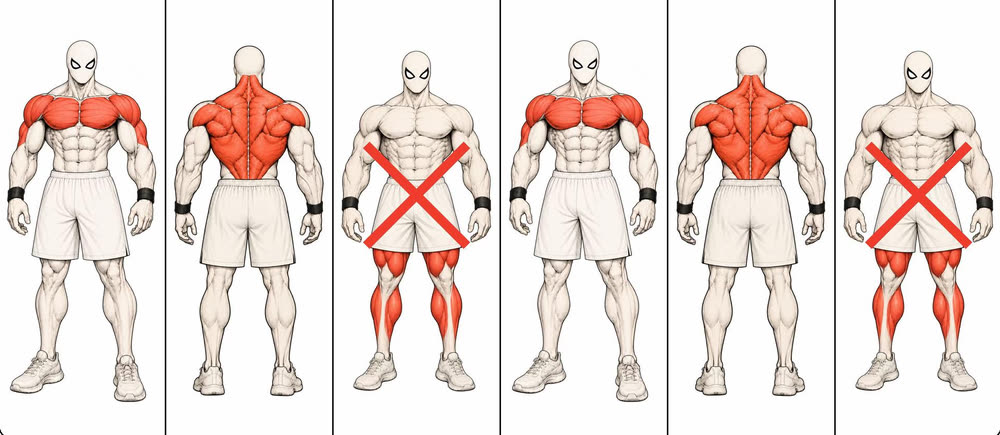
This is a push/pull/legs schedule with the leg days quietly dropped. Your upper body gets plenty of work, but quads, hamstrings, glutes and calves get none. Those are some of the biggest muscles you have, so skipping them caps your total muscle growth and leaves you unbalanced. If legs are the session you keep skipping, a split with fewer, shorter leg days will serve you better than pretending they don't exist.
#4Bro split: works, but once a week
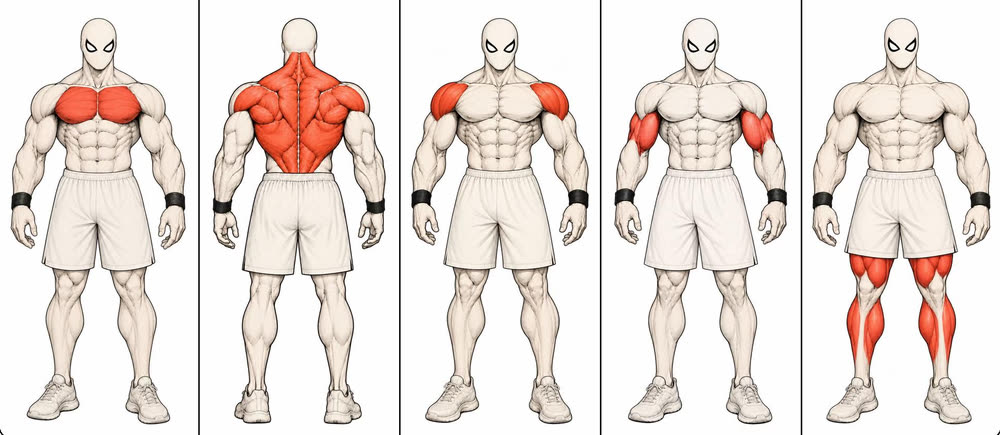
Chest day, back day, shoulder day, arm day, leg day. The bro split can build muscle, and plenty of people have grown on it. The catch is that each muscle gets trained once a week, so all of its weekly sets land in one session. By the later sets you're tired and quality drops. You also need five visits to train everything once. If you like it, keep it, but splitting the same sets across two days per muscle is the easier way to get more out of them.
#3PPL ×2: great if you can show up six days
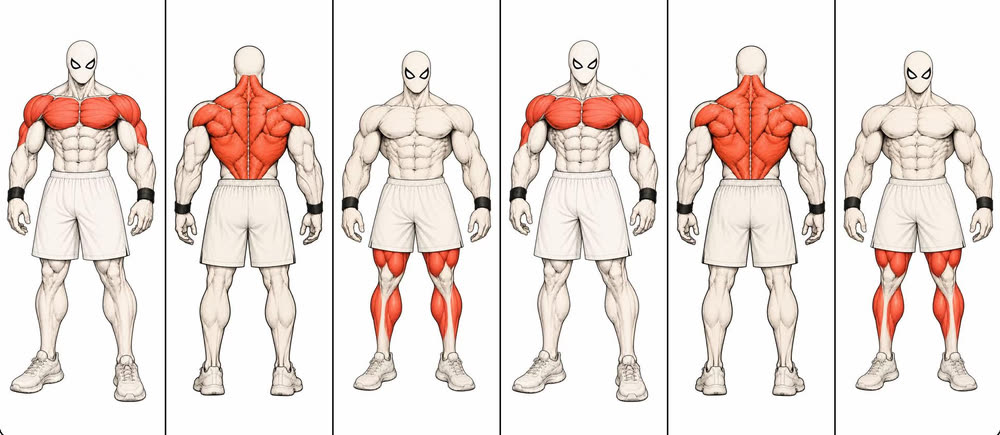
Push, pull, legs, then repeat. Every muscle gets trained twice a week and each session stays focused, so you can push hard on every set. The only real downside is the schedule: six days is a lot to sustain alongside work, sleep and life. Miss two sessions and a whole muscle group drops to once that week. Choose it if six days genuinely fits your week.
#2Upper/lower ×2: the best 4-day option
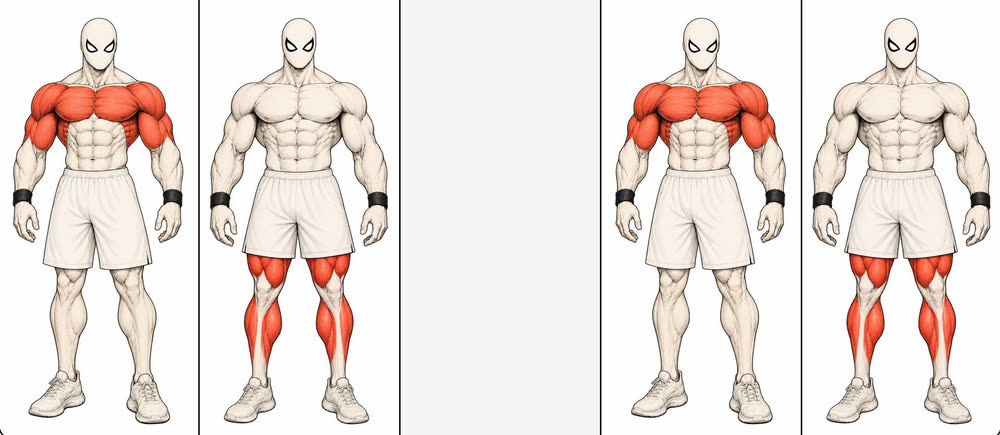
Upper, lower, rest, upper, lower. You hit every muscle twice a week with only four sessions, which makes it the most efficient split on this list and a great fit for beginners or anyone short on time. Sessions get a bit longer, since each upper day covers chest, back, shoulders and arms. Keep that manageable by picking one or two main lifts per muscle instead of trying to do everything.
#1PPL + upper/lower: our pick
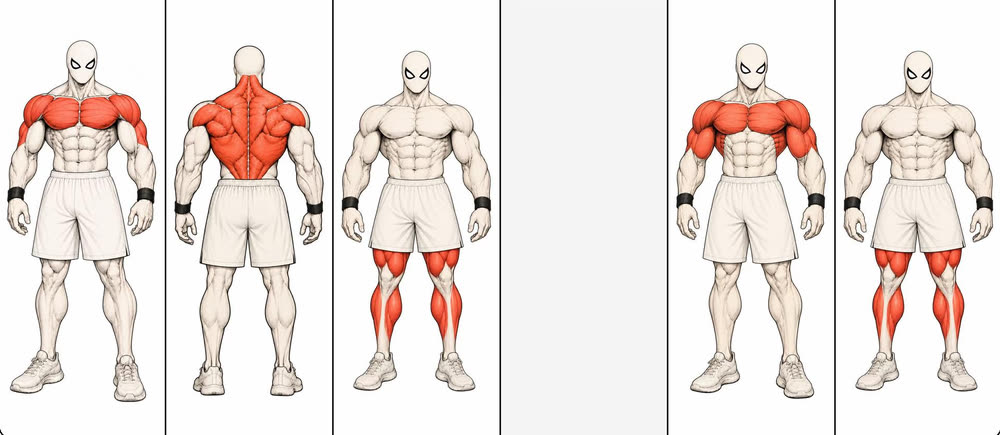
Push, pull, legs, rest, upper, lower. You get the focused sessions of PPL early in the week, then upper/lower covers everything a second time. Every muscle is trained twice, sessions stay a reasonable length, and the rest day sits right where fatigue builds up. Five days is a commitment, but it's one day less than PPL ×2 for the same twice-a-week frequency.
How to choose your split
- 3 days a week: full body each session. None of the five above fit, and that's fine.
- 4 days: upper/lower ×2.
- 5 days: PPL + upper/lower.
- 6 days: PPL ×2, if you can genuinely keep it up.
Whichever you choose, the split only works if the sets actually happen. Track every session and aim to beat last time's weight or reps, even by a little.
Log it in Gymarc
Gymarc is a workout tracker you just type into. Here's what an upper day from the #1 split looks like, one line per exercise:
e.g. bench 3x8 60Log
row 3x10 50Barbell Row · 3 sets of 10 at 50 kgohp 3x8 35Overhead Press · 3 sets of 8 at 35 kgpulldown 3x10 45Lat Pulldown · 3 sets of 10 at 45 kgcurls 3x12 12Bicep Curl · 3 sets of 12 at 12 kgEach line becomes a logged exercise, and the next time you train you'll see exactly what to beat.
Get Gymarc before everyone else
The iPhone workout tracker with no menus. Join the waitlist and get the beta early.
Free. One email at launch. No spam.
Sources
- Schoenfeld BJ, Ogborn D, Krieger JW. Effects of resistance training frequency on measures of muscle hypertrophy: a systematic review and meta-analysis. Sports Medicine, 2016. PubMed 27102172
- Schoenfeld BJ, Grgic J, Krieger J. How many times per week should a muscle be trained to maximize muscle hypertrophy? Journal of Sports Sciences, 2019. PubMed 30558493
- Schoenfeld BJ, Ogborn D, Krieger JW. Dose-response relationship between weekly resistance training volume and increases in muscle mass. Journal of Sports Sciences, 2017. PubMed 27433992
- Pelland JC et al. The resistance training dose-response: meta-regressions exploring the effects of weekly volume and frequency on muscle hypertrophy and strength gain. SportRxiv preprint. SportRxiv